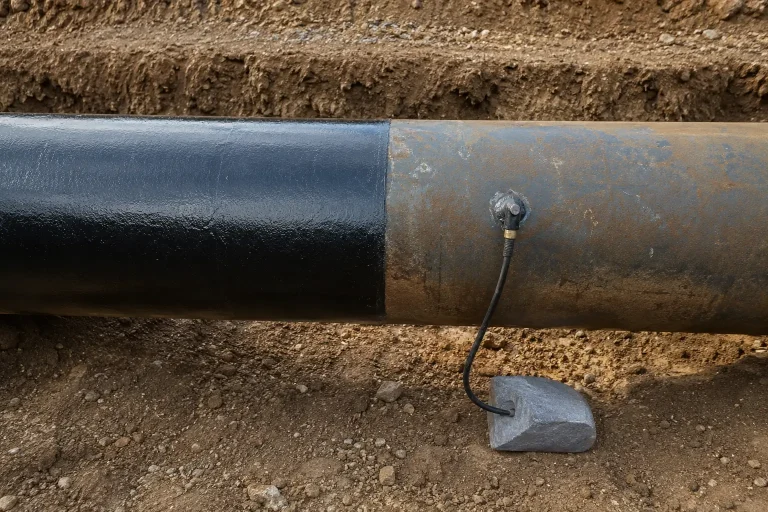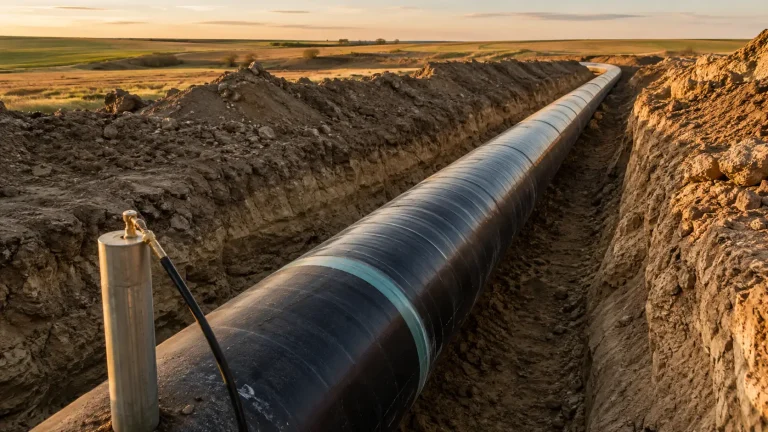
Cathodic protection kits are available on the market that promise to protect a tank or a pipe section with no more work than burying a few anodes and connecting a cable. For some small installations they can be a reasonable option, but in many others they leave the steel unprotected, or only partly protected, without anyone noticing until the first leak appears.
In this article we explain what a kit includes, when it can be enough, what its limits are and what an engineered system adds, so that you can make an informed decision about what your installation needs.
What a cathodic protection kit includes
A cathodic protection kit is usually a set of ready-to-install materials for small structures. It typically contains:
- One or more sacrificial anodes, usually magnesium or zinc, pre-packaged in a bag with activating backfill and with the cable already attached.
- Cable and connectors to join the anodes to the structure.
- A connection box or terminal, in some cases with a test point to measure the potential.
- Installation instructions that are generic, designed for a “standard” structure.
It works like any galvanic system: the anode, more active than steel, is gradually consumed and protects the structure it is connected to. If you want to review the principle, we explain it in what cathodic protection is and how it works.
They should not be confused with insulating kits (dielectric gaskets, sleeves and washers for flanges), which are also sold as cathodic protection material. They do not protect the structure on their own: they electrically isolate it from what is not to be protected, and they are a necessary complement in most systems.
When a kit can be enough
A kit can be enough when several conditions are met at the same time:
- The structure is small: a low-capacity LPG or diesel tank, a short pipe section or a small water tank.
- It has a coating in good condition, so the current required is low.
- The soil has low or medium resistivity and there are no stray currents nearby (railway or tram lines, direct current systems).
- The structure is electrically isolated from earthing networks and other pipes.
- A leak would not have serious consequences and the installation is not subject to regulations that require a design.
Even in these cases, a kit only does its job if the structure potential is then measured to check that it meets the protection criterion. Without that measurement, there is no way of knowing whether the system works.
The limits of cathodic protection kits
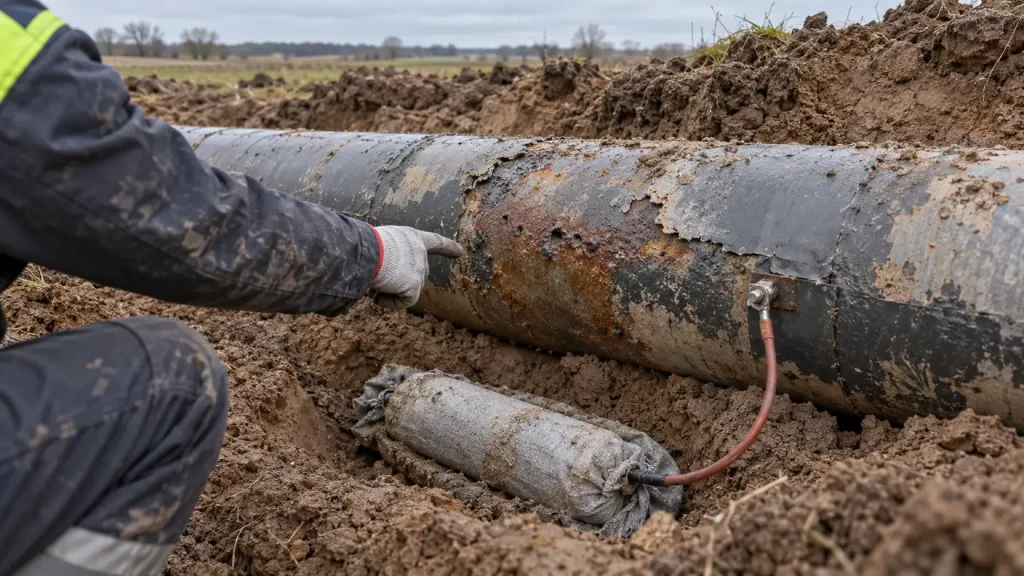
The problem with cathodic protection kits is not the material, which is usually the same as that used in engineered projects, but that they are applied without knowing the installation. A kit does not know how much surface has to be protected, what condition the coating is in or what the soil resistivity is. This has several consequences:
- Insufficient protection: if the current the anodes deliver is lower than the structure needs, corrosion continues in the least protected areas, even though anodes are installed.
- Unknown service life: without a calculation, nobody knows how many years the anodes will last. They can run out in a few years and leave the structure unprotected without anyone noticing.
- Losses due to lack of isolation: if the structure is connected to a copper earthing network or to other pipes, the current is shared among all of them and the protection does not reach the tank or pipe.
- Interference: stray currents or nearby cathodic protection systems can cancel out the effect of the kit or even speed up corrosion at certain points.
- Overprotection: in poorly adjusted systems, an excessively negative potential can cause coating disbondment and, in high-strength steels, hydrogen embrittlement.
- No documentation: a kit provides no calculations, drawings or commissioning values, which are what an inspection or an insurer will ask for.
What an engineered system adds
An engineered cathodic protection system starts from the real installation, not from a standard structure. The work follows these steps:
- Preliminary study: measurement of soil resistivity, coating condition, electrical continuity, isolation from other structures and possible stray currents.
- Calculation of the current required and of the anode mass or rectifier output for the whole service life set in the design.
- Choice of the most suitable system, sacrificial anodes or impressed current. We explain the differences in sacrificial anodes versus impressed current.
- Installation and commissioning, measuring the “on” and “off” potentials to check that the whole structure is protected and to adjust the system if necessary.
- Technical documentation and a maintenance plan with periodic measurements.
In addition, the design follows the regulations applicable to each structure: EN 12954 for buried structures in general, ISO 15589-1 for pipelines or EN 13636 for buried tanks. If your case is a pipeline or a tank, you can see how they apply in cathodic protection for buried pipelines and gas pipelines and in cathodic protection for storage tanks and vessels.
Kit or engineered system compared
| Criterio | Cathodic protection kit | Engineered system |
|---|---|---|
| Starting point | A “standard” structure | The real installation, with prior measurements |
| Current and service life | Not calculated | Calculated for the surface, coating and soil |
| Isolation and interference | Depends on the installer | Studied and resolved in the design |
| Verification | Only if someone measures afterwards | Commissioning with “on” and “off” potentials |
| Documentation | Generic instructions | Calculations, drawings and commissioning values |
| Initial cost | Low | Higher, due to the study and design |
| Cost over the service life | Uncertain: replacements and repairs if it fails | Predictable: planned maintenance |
| Suitable for | Small, well-coated, non-critical structures | Tanks, pipelines and critical or regulated structures |
How to decide what your installation needs
Before choosing, it helps to answer a few questions. If the answer to any of them is “yes” or “I don’t know”, the prudent choice is an engineered system:
- Does the structure contain fuel, gas, chemicals or drinking water?
- Is it subject to regulations, periodic inspections or insurer requirements?
- Is it large, or are there several tanks or pipe sections connected to each other?
- Is the coating old, or do you not know its condition?
- Are there railway or tram lines, substations or other cathodic protection systems nearby?
- Is it connected to the building’s earthing network or to other metal pipes?
A middle way with materials sized by a technician

Small structures do not always need a complex design. An intermediate option is for a technician to study the installation, calculate the number and type of anodes and define where to place them, and for the installation to be carried out with standard materials like those in a kit. This keeps the installation simple, but with the assurance that the current is sufficient and that the result is checked by measuring potentials.
At Procainsa we supply the materials for this type of installation (anodes, reference electrodes, test points, insulating joints), always sized for each case.
Tailored cathodic protection with Procainsa
Since 1988 we have designed, installed and maintained cathodic protection systems for pipelines, tanks and industrial structures, with a NACE-certified technical team. We study each installation, propose the simplest solution that genuinely protects it and check the result. If you already have a system installed, we can also review it with our inspection service.
Frequently asked questions about cathodic protection kits
Can I install a cathodic protection kit myself?
Physically installing a few sacrificial anodes is not complicated, but the result depends on details such as the distance to the tank, electrical isolation or the cable connections. Above all, it is essential to measure the potential afterwards with a reference electrode to check that the structure is protected.
How long does an anode kit last?
It depends on the current it has to deliver, which in turn depends on the size of the structure, the coating and the soil. Since a kit is not calculated for each case, its life is uncertain: it can last many years on a small, well-coated structure, or run out quickly on a more demanding one.
Does a kit comply with regulations?
The material may comply, but regulations require the system to protect the structure and for this to be verified by measurements. A kit installed without calculation or commissioning does not provide that justification, so regulated installations usually need a design.
What is an insulating kit for cathodic protection?
It is a set of dielectric gaskets, sleeves and washers fitted to a flanged joint to break the electrical continuity between two sections. It is used so that the protection current is not lost to installations that are not to be protected. It is a complement to the system, not protection in itself.
Not sure whether a kit is enough? Tell us about your installation and we will tell you what solution you need. Request information.