
Buried steel pipes, whether local distribution networks or large-diameter gas pipelines, are permanently in contact with the ground, one of the most aggressive electrolytes for carbon steel. Without cathodic protection, corrosion in these facilities progresses constantly and often invisibly from the outside, until it causes leaks with severe safety and environmental consequences.
In this article, we explain why cathodic protection in buried pipes and gas pipelines is essential, what causes corrosion in these facilities, how an appropriate system is designed, which regulations apply, and what differences exist between protecting a local section, a large-diameter gas pipeline, or a submarine pipeline.
Why Do Buried Pipes and Gas Pipelines Need Cathodic Protection?
Carbon steel, the predominant material in buried pipes and gas pipelines, naturally corrodes when in contact with the ground. The rate of this corrosion depends on factors such as soil resistivity, moisture, pH, and the presence of stray currents, but in practically all cases, it is fast enough to compromise the pipeline’s integrity long before the end of its design life if cathodic protection is not applied.
In addition to the repair cost, a leak in a gas pipeline or hydrocarbon transport pipeline can have safety, environmental, and regulatory consequences far exceeding the cost of having installed cathodic protection from the beginning. This is why standards such as NACE SP0169 and ISO 15589-1 require cathodic protection in practically any buried steel pipeline intended for the transport of gas, oil, or their derivatives.
Main Causes of Corrosion in Buried Pipelines
Before designing a cathodic protection system, it is necessary to understand what causes corrosion in each specific facility. The most relevant factors are:
- Soil resistivity: low-resistivity soils (clay, moist, saline) promote faster and more uniform corrosion.
- Soil pH: acidic soils accelerate the corrosion of carbon steel.
- Moisture and water table: the presence of groundwater increases the conductivity of the electrolyte in contact with the pipeline.
- Stray currents: generated by electric traction lines, substations, or nearby direct current facilities, they can drastically accelerate corrosion at specific points.
- Soil heterogeneity: sections where the pipeline passes through different types of soil generate natural galvanic couples between areas, promoting localized corrosion.
- Coating defects: any discontinuity in the anti-corrosion coating directly exposes the steel to the ground at that point.
Cathodic Protection for Steel Pipelines
Carbon steel is the benchmark material in the construction of buried pipelines due to its mechanical strength and cost, but it is also a metal with a natural tendency to oxidize in the presence of moisture and oxygen. Cathodic protection reverses this process by converting the pipeline into the cathode of an electrochemical cell, so that it receives electrons instead of giving them up to the ground.
In newly installed steel pipelines, cathodic protection is always combined with an anti-corrosion coating (usually fusion-bonded epoxy, FBE), which drastically reduces the exposed metal surface area and, consequently, the required protection current. In older pipelines or those with degraded coatings, the cathodic protection system must be sized for a larger exposed surface area.
Design of a Cathodic Protection System for Pipelines
The design of a cathodic protection system for pipelines always begins with a specific engineering study, which includes:
- Soil resistivity survey along the entire pipeline route, usually using the Wenner method.
- Calculation of current density required based on the condition and type of coating.
- Estimation of exposed metal surface area, considering the quality and age of the coating.
- Selection of the system most suitable: sacrificial anodes for short sections or areas with difficult electrical access, impressed current for longer pipelines.
- Definition of protection criteria according to applicable standards, usually based on the pipeline potential relative to a copper-copper sulfate reference electrode.
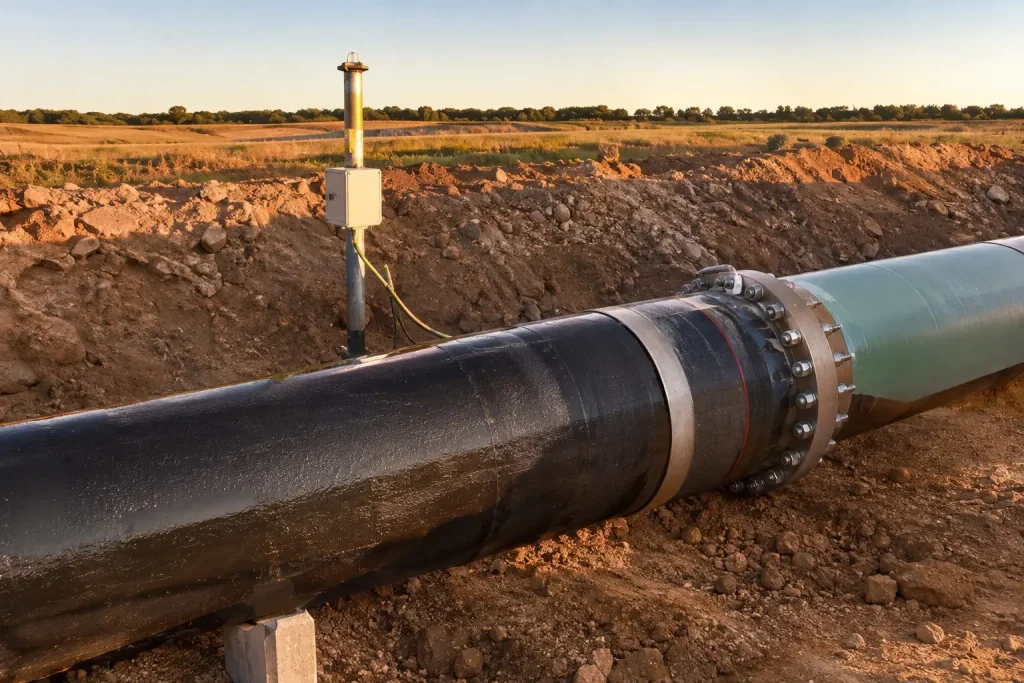
- Location of test points (test posts) to allow periodic verification of the system along the route.
- Interference study with other nearby buried facilities and potential sources of stray currents.
You can learn in detail about our design and installation service for cathodic protection systems at cathodic protection, where we also explain how it is combined with anti-corrosion coatings and the differences between sacrificial anodes and impressed current.
Sacrificial Anodes or Impressed Current: What Suits Each Pipeline Section
| Factor | Sacrificial anodes | Impressed current |
|---|---|---|
| Pipeline length | Short or medium sections | Long sections, gas pipelines, and oil pipelines |
| Access to electrical supply | Not required | Essential at each rectifier station |
| Soil resistivity | Performs better in low-resistivity soils | Also effective in high-resistivity soils |
| Risk of interference | Low | Requires study in sections parallel to high-voltage lines or electrified tracks |
| Maintenance | Periodic replacement of depleted anodes | Verification of rectifiers and current adjustment |
Cathodic protection in gas pipelines and large-diameter pipelines
Gas pipelines and large-diameter pipelines present specific design challenges compared to a local distribution pipeline:
- Greater route length, which usually requires impressed current cathodic protection with several rectifier stations distributed along the route.
- Greater risk of stray current interference, especially in sections parallel to high-voltage lines or electrified railway tracks.
- Need for insulating joints to divide the system into independent sections and facilitate its management and verification.
- Higher regulatory and safety requirements, given the volume and nature of the fluid transported.
- Coordination with other nearby buried infrastructure, to avoid mutual interference between cathodic protection systems of different owners.
Cathodic protection in subsea and offshore pipelines
Subsea pipelines and offshore infrastructure add an additional layer of complexity: seawater is an electrolyte with much lower resistivity than soil, which favors higher protection currents but also a more efficient performance of sacrificial anodes, typically made of aluminum or zinc in this environment. Limited access for inspection and maintenance makes the initial design and the system’s safety margin especially critical, as any subsequent intervention is significantly more expensive than in an onshore installation.
You can see a real example of this type of project in our case study of life extension of an offshore pipeline.
Do you need to design or review the cathodic protection of a pipeline or gas pipeline? At Procainsa, we have been designing cathodic protection systems for buried, subsea, and offshore installations for over 35 years, with NACE-certified technicians. Request more information about our cathodic protection service.
Standards applicable to cathodic protection in pipelines
The design and execution of cathodic protection systems in buried pipelines and gas pipelines are governed by specific international standards:
- NACE SP0169: reference standard for corrosion control on underground or submerged metallic piping systems by cathodic protection.
- ISO 15589-1: specific to onshore steel pipeline transportation systems, defines protection criteria and design requirements.
- UNE-EN 12954 series: equivalent European standard, applicable to buried or submerged metallic structures.
- NACE SP0502 (ECDA): applicable when opting for direct assessment of external corrosion as an alternative or complement to intelligent pig inspection.
These standards define, among other aspects, the potential criteria that the pipeline must meet to be considered protected, avoiding both underprotection and overprotection.
Maintenance and verification of cathodic protection in buried pipelines
A well-designed cathodic protection system requires periodic verification to confirm that it continues to function within established criteria. This is carried out using infrastructure inspection techniques such as CIPS (Close Interval Potential Survey) or DCVG, which allow checking the protection level and detecting coating defects along the entire route.
This periodic verification is part of a broader installation integrity management plan, which combines inspection, cathodic protection, and predictive maintenance to maximize the useful life of the pipeline or gas pipeline.
Real case studies of cathodic protection in pipelines
Some examples of pipeline cathodic protection projects we have developed at Procainsa:
- Study of a buried pipeline network, with a complete assessment of the installation’s condition.
- Life extension of an offshore pipeline made of API 5L X52 steel, in service since the 90s.
- Cathodic protection system in gas stations, applied to double-walled buried pipes and tanks.
Frequently asked questions about cathodic protection in pipelines and gas pipelines
Is it necessary to apply cathodic protection to all buried steel pipelines?
In critical gas, oil, or chemical transport facilities, yes, and this is required by reference international standards. In less critical facilities, the decision depends on a risk analysis considering the design life, soil resistivity, and the consequences of a potential failure.
What is the difference between protecting a buried steel pipe and a large-diameter gas pipeline?
The main difference lies in the scale and the chosen system. A local distribution pipe can be protected with sacrificial anodes in a simple and autonomous manner. A large-diameter, long-distance gas pipeline almost always requires impressed current cathodic protection, with multiple rectifier stations, insulating joints, and a more thorough interference study with other nearby facilities.
How is the appropriate cathodic protection system calculated for a pipeline?
It is calculated based on field-measured soil resistivity, the condition and type of pipeline coating, the estimated exposed metallic surface area, and the required design life. With these data, the necessary current density is determined and the number and type of anodes are sized, or the capacity of the rectifier in the case of impressed current.
How often should a pipeline with cathodic protection be verified?
The frequency depends on the applicable regulations and the criticality of the installation, but as a general reference, verifications using CIPS or DCVG are usually performed every 3-5 years on high-pressure pipelines, in addition to more frequent spot checks of potential at test points.
Is cathodic protection in a subsea pipeline different from an underground one?
Yes. Seawater has a much lower resistivity than soil, which changes system sizing and favors the use of aluminum or zinc sacrificial anodes. Furthermore, limited access for inspection and maintenance in subsea or offshore installations requires designs with a higher safety margin, as subsequent interventions are much more costly.
What happens if a buried pipeline has been without cathodic protection for years?
It may have been corroding for years without being visible from the outside. It is recommended to perform a pipeline condition assessment, such as an ECDA (External Corrosion Direct Assessment), before designing the cathodic protection system, to size it correctly and prioritize areas that already show greater deterioration.
Do you have a cathodic protection project for pipelines or gas pipelines? Our technical team analyzes your installation and proposes the most suitable system, with more than 35 years of experience in the Oil & Gas and petrochemical sector. Request information.