Once it has been decided that an installation needs active cathodic protection, the next technical question is which of the two existing systems to use: sacrificial anodes or impressed current. They are not two brands or two different qualities of the same thing, but two different operating principles, each with clear advantages depending on the type of installation.
In this article, we explain how each system works, their real technical differences, and what factors determine which is appropriate in each case.
What are sacrificial anodes
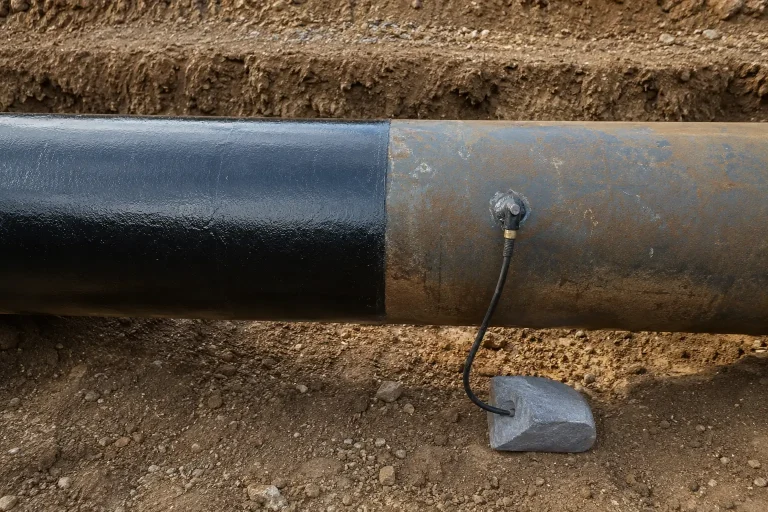
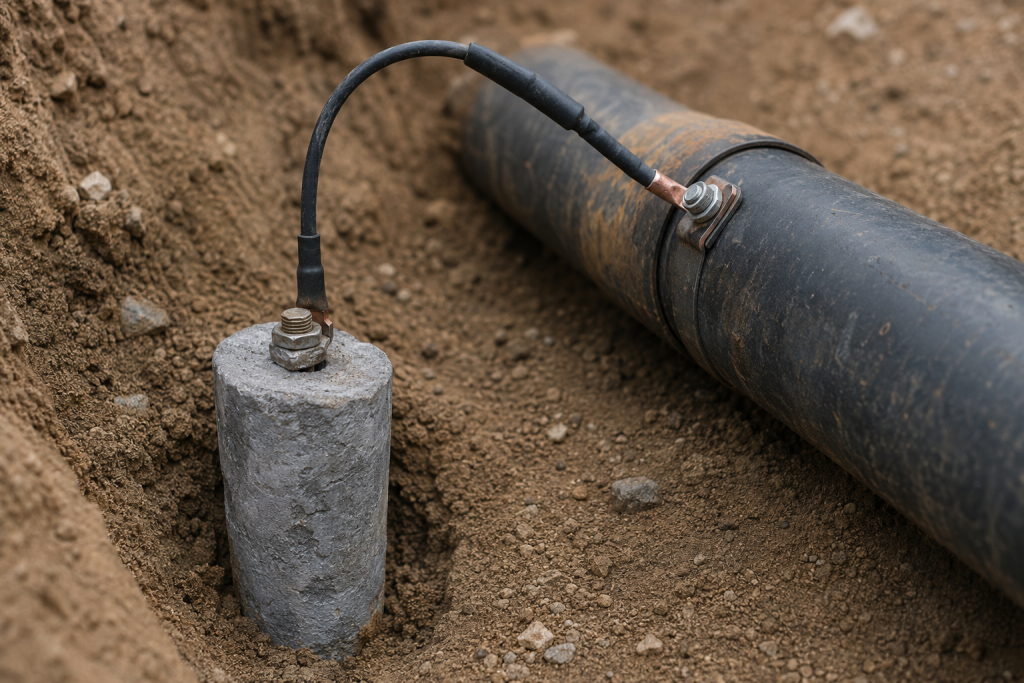
Sacrificial anodes, also known as galvanic protection, are metals more reactive than the metal to be protected. When electrically connected to the structure, a galvanic current is spontaneously generated: the anode gives electrons to the protected structure and corrodes itself instead, hence the term “sacrifice”.
This system does not require any external power source. The protection current arises from the natural potential difference between the two metals, so it operates completely autonomously from the moment of its installation.
The most common sacrificial metals in industrial applications are:
- Zinc: suitable in low resistivity soils and water, such as wet soils or seawater.
- Magnesium: offers greater driving force, useful in medium or high resistivity soils.
- Aluminum: widely used in offshore and marine structures due to its good performance and lower weight.
What is impressed current cathodic protection
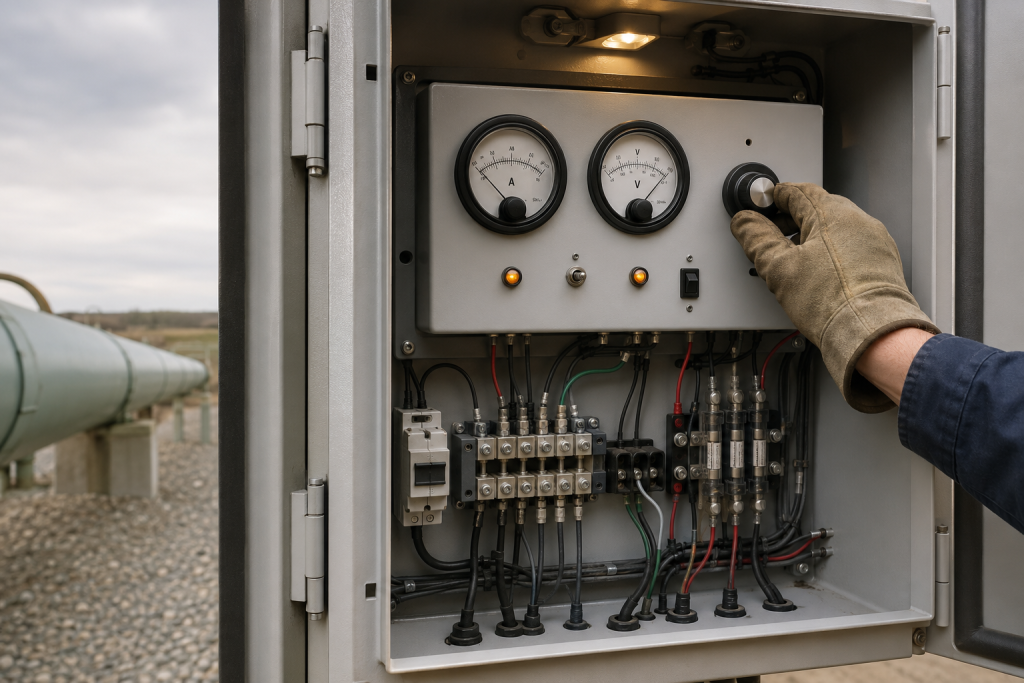
La protección por corriente impresa utiliza una fuente de alimentación externa, generalmente un rectificador conectado a la red eléctrica, que impone una corriente continua controlada hacia la estructura a proteger. La corriente circula a través de ánodos inertes, normalmente de grafito, titanio activado o hierro-silicio, que no se consumen de forma significativa con el tiempo.
Unlike sacrificial anodes, here the level of applied current can be adjusted in the rectifier, allowing for much more precise control of the degree of protection at all times during the installation’s life.
Differences between sacrificial anodes and impressed current
| Aspect | Sacrificial anodes | Impressed current |
|---|---|---|
| Source of protection current | Galvanic potential difference between metals | External power source (rectifier) |
| Requiere suministro eléctrico | No | Yes |
| Current adjustment capability | Fixed, according to the galvanic pair installed | Adjustable in the rectifier |
| Extensión de instalación recomendada | Estructuras de tamaño pequeño o medio | Large-scale structures, such as gas pipelines or oil pipelines |
| Anode lifespan | Limited, they are consumed and require periodic replacement | Inert anodes with much longer lifespan |
| Initial cost | Menor | Higher, due to the rectifier and electrical installation |
| Coste de operación | Sin consumo eléctrico | Continuous electrical consumption of the rectifier |
| Risk of interference with nearby installations | Low | Mayor, requiere estudio de interferencias en instalaciones próximas |
When to use sacrificial anodes
- Small or medium-sized installations, such as individual tanks or short pipe sections.
- Locations without access to electrical supply, such as remote or marine structures.
- Low resistivity soils or environments, where the galvanic couple performs efficiently.
- Projects where a low initial cost and simple installation are prioritized, without the need for electrical maintenance.
When to use impressed current
- Large-scale installations, such as gas pipelines, oil pipelines, or complete tank farms.
- High resistivity soils, where sacrificial anodes would require an impractical amount of material.
- Installations where precise and adjustable control of the protection level over time is required.
- Projects with a very long design life, where the limited lifespan of sacrificial anodes would necessitate frequent replacements.
Is it possible to combine both systems in the same installation
Yes. In complex installations, it is common to use impressed current as the main system for the bulk of the structure, and reinforce with sacrificial anodes specific points of difficult access, electrically isolated areas, or sections added later to the original installation. The final decision always depends on an engineering study that considers the extent of the installation, soil resistivity, electrical availability, and the required design life.
Frequently asked questions about sacrificial anodes and impressed current
Qué diferencia hay entre ánodos de sacrificio y protección galvánica
None. Galvanic protection is the technical name for the same system commonly known as sacrificial anode protection. Both terms describe the use of a more reactive metal that corrodes in a controlled manner to protect the main structure.
Can sacrificial anodes be used in long buried pipelines
Technically it is possible, but it is rarely the most efficient option. For large-scale pipelines, impressed current allows protecting the entire length with fewer installation points and more precise control, whereas sacrificial anodes would require a very high number of units distributed along the route.
Qué mantenimiento necesita cada sistema
Los ánodos de sacrificio requieren inspección periódica de su estado de consumo y sustitución cuando se agotan. La corriente impresa requiere verificación periódica del rectificador, de los niveles de corriente y tensión aplicados, y comprobación de que los ánodos inertes y el cableado se mantienen en buen estado.
Cuál de los dos sistemas es más económico a largo plazo
Depende de la instalación. Los ánodos de sacrificio tienen menor coste inicial pero requieren sustitución periódica del material consumido. La corriente impresa tiene mayor coste inicial pero un coste de mantenimiento por unidad protegida más bajo en instalaciones grandes, además de mayor vida útil de sus componentes. En instalaciones de gran extensión, la corriente impresa suele resultar más económica a largo plazo.