When talking about protecting a buried pipeline, a storage tank, or an offshore infrastructure against corrosion, one is actually referring to two distinct and complementary strategies: passive protection and active cathodic protection. Confusing them, or assuming that only one is sufficient, is one of the most frequent design errors in industrial installations.
In this article, we explain what each one is, their technical differences, and why at Procainsa we recommend combining them in almost all the projects we undertake.
What is passive corrosion protection?
Passive protection is based on a very simple principle: physically isolating the metal from the electrolyte that causes corrosion (soil, water, seawater). If the metal is not in direct contact with that environment, the electrochemical reaction that degrades it cannot occur.
In practice, this is achieved through coatings and coverings applied directly to the metal surface:
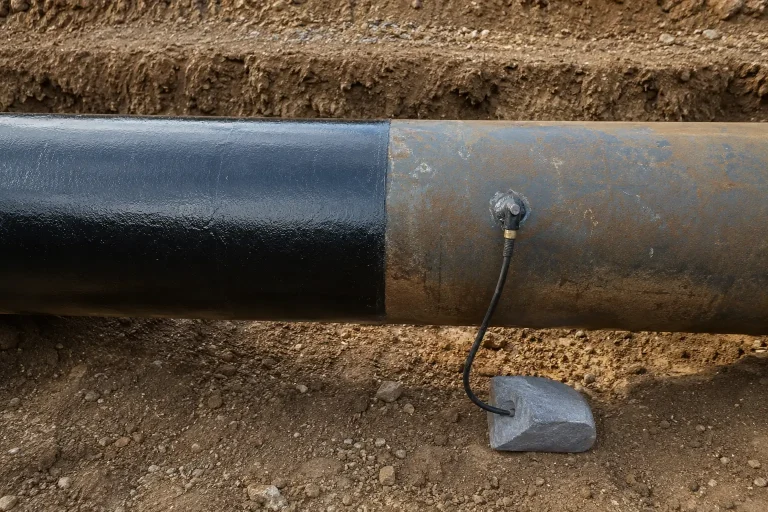
- Fusion Bonded Epoxy (FBE) Coatings: the most common system for newly constructed steel pipelines.
- Polyethylene or Polypropylene Tapes: used for weld joints and repairs.
- Revestimientos de alquitrán de hulla o coal tar: presentes en instalaciones antiguas, hoy en desuso por motivos ambientales.
- Epoxy and Polyurethane Paints: common in storage tanks and offshore structures.
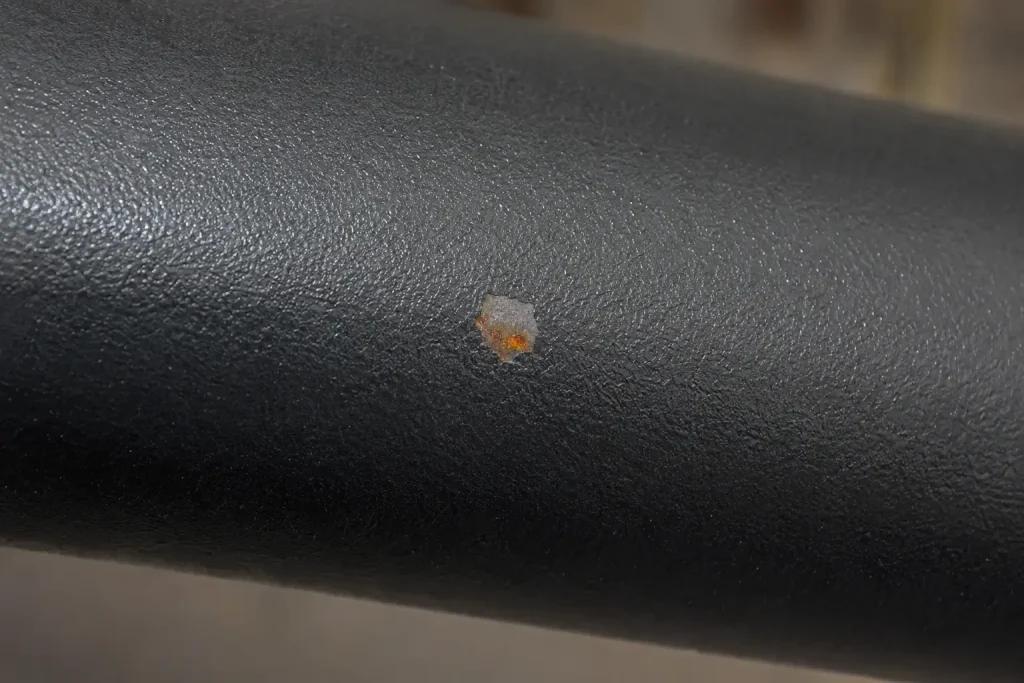
The problem with passive protection is that no coating is perfect or permanent. During manufacturing, transport, installation, or simply over time, localized defects known as holidays appear: small discontinuities in the coating where the metal is exposed to the electrolyte. A single holiday is enough for corrosion to start at that specific point, in a localized and often more aggressive way than if there were no coating at all.
What is active protection or electrochemical cathodic protection
Active protection, which we normally refer to simply as cathodic protection, does not attempt to isolate the metal from the electrolyte, but rather to change its electrochemical behavior. The metal structure becomes the cathode of an electrochemical cell, so that instead of losing electrons (oxidizing, corroding) it receives them from an external source.
Esa fuente externa puede ser un metal más reactivo que se sacrifica en su lugar (ánodos de sacrificio) o una corriente eléctrica controlada suministrada por un rectificador (protección catódica por corriente impresa). A diferencia de la protección pasiva, la protección activa sigue funcionando incluso en los puntos donde el revestimiento ha fallado, precisamente porque no depende de una barrera física.
Why passive protection alone is not enough
No serious corrosion engineer recommends relying solely on coating for critical installations. The reasons are clear:
- Todo revestimiento, por bueno que sea, desarrolla defectos con el tiempo.
- Los defectos no son visibles desde el exterior en una tubería enterrada o sumergida.
- Corrosion at a holiday point can be faster and more localized than generalized corrosion.
- Repairing a damaged coating in a buried installation involves excavation, with the cost and operational disruption that entails.
That is why reference international standards, such as NACE SP0169 and ISO 15589, require active cathodic protection for critical buried and submerged pipelines, regardless of the quality of the applied coating.
Comparison table between passive protection and active cathodic protection
| Aspect | Protección pasiva (revestimientos) | Active protection (cathodic) |
|---|---|---|
| Operating principle | Isolates the metal from the electrolyte using a physical barrier | Converts the metal into the cathode of an electrochemical cell |
| Protects against corrosion on its own | Only while the coating remains intact | Yes, continuously throughout its design service life |
| Requires electric current | No | Only in the case of impressed current; not in sacrificial anodes |
| Vulnerable to localized defects | Yes, a single holiday can initiate localized corrosion | No, it also protects at points where the coating fails |
| Requires periodic maintenance | Visual inspection and spot repair | Potential verification and anode replacement or rectifier adjustment |
| Relative initial cost | Bajo a medio | Medio a alto, según extensión de la instalación |
| Recommended use | As a first line of defense in any buried or submerged metallic installation | As a mandatory complement in critical installations, covering coating failures |
How passive protection and active cathodic protection are combined in practice
En el diseño de ingeniería moderno, la protección pasiva y la protección catódica activa no se plantean como alternativas, sino como dos capas de un mismo sistema de protección frente a la corrosión:
- El revestimiento actúa como primera línea de defensa, reduciendo drásticamente la superficie metálica expuesta al electrolito.
- La protección catódica activa actúa como segunda línea, protegiendo específicamente los puntos donde el revestimiento ha fallado.
This combination has a very relevant additional advantage from an economic point of view: by reducing the exposed metallic surface, the cathodic protection current needed to protect the entire installation is reduced by several orders of magnitude compared to what would be required to protect the same structure without any coating. This allows for the design of smaller, more economical cathodic protection systems with longer-lasting anodes.
Cuándo es imprescindible añadir protección catódica activa al revestimiento
Although it is advisable to combine both whenever possible, there are scenarios where active cathodic protection ceases to be a recommendation and becomes a requirement:
- Buried or submerged pipelines for gas, oil, or chemical products, where a leak has serious safety or environmental consequences.
- Installations subject to regulations that explicitly require cathodic protection, such as regulated gas pipelines, oil pipelines, or storage tanks.
- Instalaciones con una vida útil de diseño larga (décadas), donde la degradación acumulada del revestimiento a lo largo del tiempo es inevitable.
- Buried or submerged installations with difficult access, where inspecting or repairing the coating is costly or unfeasible.
Necesita evaluar si su instalación cuenta con la protección adecuada?
At Procainsa, we have been designing cathodic protection systems that complement existing coatings for over 35 years, with NACE certified technicians.
Preguntas frecuentes sobre protección catódica pasiva y activa
La protección catódica sustituye al revestimiento?
No. Active cathodic protection and coating fulfill complementary, not substitute, functions. The coating reduces the exposed metallic surface and, with it, the necessary protection current; active cathodic protection covers the points where the coating inevitably fails over time. The combination of both is standard practice in critical industrial installations.
Is it mandatory to combine passive and active protection?
Depende del tipo de instalación y de la normativa aplicable. En tuberías enterradas o sumergidas de gas, petróleo y productos químicos, normas como NACE SP0169 e ISO 15589 exigen protección catódica activa además del revestimiento. En otras instalaciones menos críticas, la decisión depende del análisis de riesgo y de la vida útil de diseño requerida.
Qué pasa si una instalación solo tiene revestimiento, sin protección catódica activa?
As long as the coating remains intact, the installation is protected. However, as soon as the first defect or holiday appears, that point becomes completely unprotected, and corrosion can advance rapidly and locally, without any mechanism to stop it, until it is detected by an inspection or until a failure occurs.
Cómo se sabe si una instalación necesita protección catódica activa además del revestimiento?
Se determina mediante un análisis de ingeniería que considera el tipo de instalación, el fluido transportado o almacenado, la normativa aplicable, la resistividad del terreno, la vida útil de diseño y la criticidad operativa. En Procainsa realizamos este análisis como primer paso de cualquier proyecto de protección catódica.
Do you have a cathodic protection project or want to audit an existing one?
Our technical team analyzes your installation and proposes the most suitable combination of passive and active protection, with over 35 years of experience in the sector.