When looking for how to protect a metallic structure against corrosion, it is common to find cathodic protection and anticorrosive treatments presented as if they were two alternatives to choose from. In industrial engineering practice this is not the case: they are two techniques with different operating principles that, in the vast majority of critical facilities, are applied together.
In this article we explain what anticorrosive treatments are, what types exist, how they differ from cathodic protection, and why at Procainsa we recommend combining them in practically all the projects we undertake.
What Are Anticorrosive Coatings and Treatments?
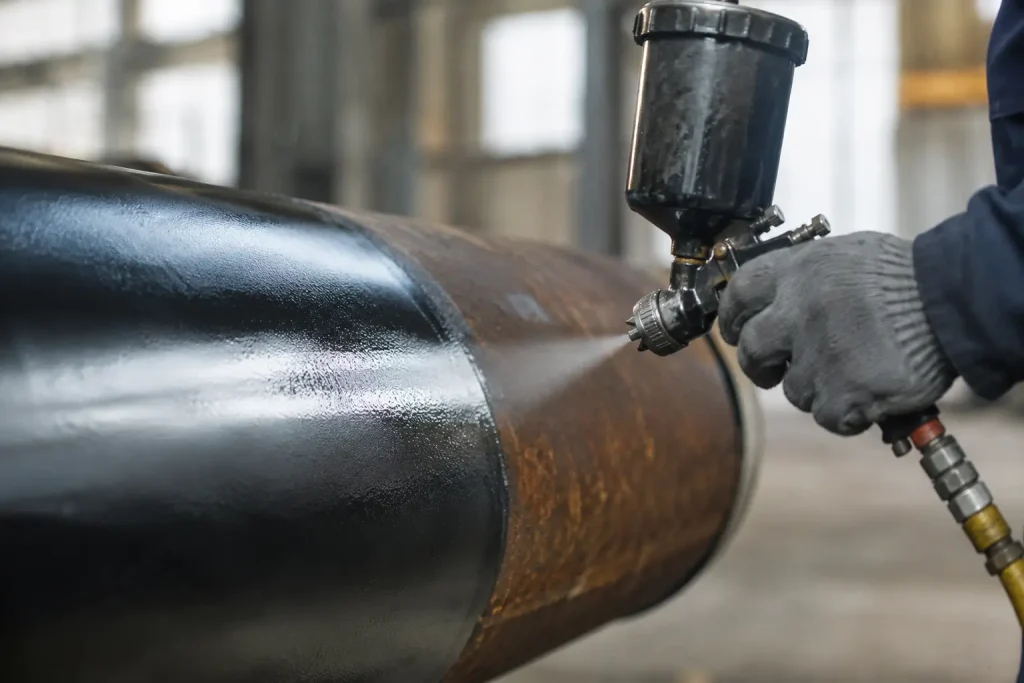
An anticorrosive treatment or coating is any product or process applied to a metal surface with the objective of physically isolating it from the aggressive environment that causes corrosion: soil, water, industrial atmosphere. Unlike cathodic protection, it does not act on the electrochemical behavior of the metal, but instead creates a physical barrier between the metal and the electrolyte.
Anticorrosive treatments are, in fact, the first line of defense in the vast majority of metallic installations, and are usually applied from the moment of manufacture or installation, even before considering whether additional cathodic protection is necessary.
Most Used Types of Anticorrosive Coatings in Industry
- Fusion-bonded epoxy coating (FBE): the most common system in newly constructed steel pipelines, applied in the factory via electrostatic spraying.
- Polyethylene or polypropylene tapes: mainly used in weld joints, repairs, and sections where applying FBE is not feasible.
- Epoxy and polyurethane paints: common in storage tanks, offshore structures, and industrial equipment exposed to the elements.
- Hot-dip galvanizing: zinc coating applied by immersion, common in metallic structures, towers, and thinner components.
- Thermal spray metallizing: application of atomized zinc or aluminum onto the surface, used on large structures that are difficult to submerge.
- Coal tar coatings: present in old installations, nowadays disused for environmental reasons.
How Anticorrosive Coatings Work Compared to Cathodic Protection
The fundamental difference between both techniques lies in the physical principle they use:
- An anticorrosive treatment isolates the metal from the electrolyte through a physical barrier. As long as that barrier remains intact, there is no contact between the metal and the aggressive environment, and therefore there is no corrosion.
- Cathodic protection does not isolate anything; it changes the electrochemical behavior of the metal, turning it into the cathode of an electrochemical cell so that it receives electrons instead of releasing them.
This difference in principle is the reason why both techniques have different limitations and complement each other so well.
Limitations of Standalone Anticorrosive Treatments
No anticorrosive treatment is perfect or permanent. Its main limitations are:
- Application defects: during manufacturing, transport, or installation, point discontinuities known as holidays may appear.
- Degradation over time: exposure to UV rays, thermal cycles, humidity, and mechanical stresses progressively degrades any coating.
- Mechanical damage: impacts, abrasion during assembly, or ground movements can damage the coating at specific points.
- No self-healing capacity: unlike cathodic protection, an anticorrosive treatment offers no protection at the exact point where it fails; corrosion begins there immediately and often in a more localized and aggressive manner than if there were no coating at all.
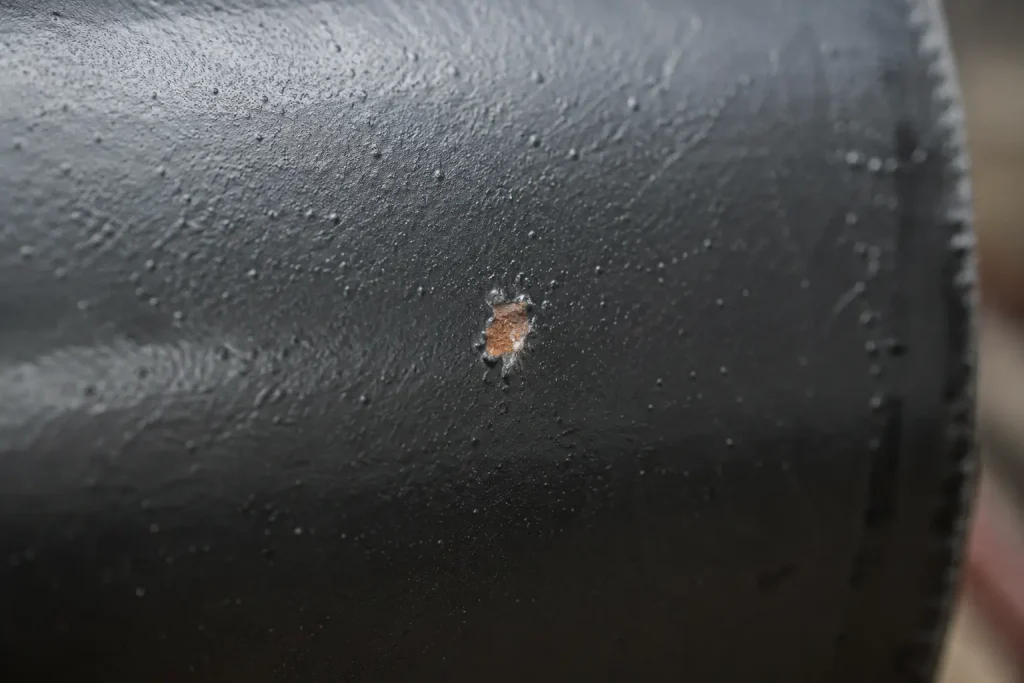
For this reason, relying solely on anticorrosive treatment in buried, submerged, or critical facilities is a practice that international standards neither permit nor recommend.
Comparison Between Cathodic Protection and Anticorrosive Treatments
| Aspect | Anticorrosive treatment | Cathodic protection |
|---|---|---|
| Operating principle | Physical barrier between the metal and the electrolyte | Change in the electrochemical behavior of the metal |
| Protects across the entire surface | Yes, as long as the coating remains intact | Yes, continuously throughout its design service life |
| Protects at points with defects | No | Yes, that is precisely its main function |
| Requires electric current | No | Only in the case of impressed current |
| Typical service life | Limited, degrades over time | Decades, with periodic maintenance |
| Relative initial cost | Bajo a medio | Medium to high |
| Recommended use | As the first line of defense in any metallic installation | As a complement in buried, submerged, or critical installations |
Why cathodic protection and anticorrosive coatings are combined in practice
In modern engineering design, both techniques are considered as two layers of the same protection system: anticorrosive treatment drastically reduces the exposed metallic surface, and cathodic protection specifically covers the points where that treatment fails over time. We analyze this combination in detail, with examples and an additional comparative table, in our article on passive and active cathodic protection.
This combination also has a relevant economic advantage: by reducing the exposed metallic surface through anticorrosive treatment, the cathodic protection current required to protect the entire installation is reduced by several orders of magnitude compared to what would be needed without any coating. This allows for designing smaller, more economical cathodic protection systems with longer anode service life.
When an anticorrosive treatment is enough and when cathodic protection is also needed
The decision depends on the type of installation, its criticality, and the applicable standards:
- Anticorrosive treatment alone is usually enough: atmospheric metallic structures, not buried or submerged, low criticality, and with easy access for inspection and repainting.
- Cathodic protection is needed in addition to treatment: buried or submerged pipelines, tanks in contact with the ground, offshore structures, and any installation where a leak or structural failure has significant safety, environmental, or economic consequences.
At Procainsa, we perform the necessary engineering analysis to determine whether your installation requires cathodic protection in addition to existing or planned anticorrosive treatment, and we design the most suitable system for each case. Learn about our cathodic protection service.
Frequently asked questions about cathodic protection and anticorrosive coatings
Is cathodic protection or anticorrosive coatings better?
Neither is better in absolute terms; they serve different and complementary functions. Anticorrosive treatment protects most of the surface economically, while cathodic protection covers the points where that treatment inevitably fails. Standard practice in critical installations is to combine both.
What anticorrosive coating is commonly used on buried pipelines?
The most common in new construction steel pipes is fusion-bonded epoxy (FBE) coating, applied in the factory. Polyethylene or polypropylene tapes are used on weld joints and repairs, as applying FBE in the field with the same quality as in the factory is not feasible.
Is galvanizing the same as cathodic protection?
No, although they are sometimes confused. Galvanizing is an anticorrosive treatment: a zinc layer applied by immersion that acts primarily as a physical barrier, although it also offers some local galvanic protection at small defects due to the reactivity of zinc. Cathodic protection, on the other hand, is a system specifically designed to electrochemically protect an entire structure using sacrificial anodes or impressed current.
How long does an anticorrosive treatment last before requiring additional cathodic protection?
It depends on the type of coating, environmental conditions, and application quality, but in critical buried or submerged installations, it is not recommended to wait for the treatment to degrade before installing cathodic protection. Both techniques are designed together from the initial project phase, precisely so that cathodic protection is operational from day one and covers defects that appear over time.
Can cathodic protection be applied to a pipeline that already has a coating?
Yes, in fact, it is the most common situation. The cathodic protection system is sized precisely based on the type and condition of the existing coating, estimating the exposed metallic surface through its potential defects.
Do you need to evaluate whether your installation needs cathodic protection in addition to the current coating? At Procainsa, we have been combining both techniques in industrial engineering projects for over 35 years. Request information.